20220216_141817.jpg

Welcome

Welcome to the Sacramento Orchid Society’s website. We hope you find the information here useful. We’ve made some changes recently so please explore the site thoroughly. You can check out our events page for information on upcoming events.

About the Sacramento Orchid Society

The Sacramento Orchid Society was founded in 1947 as an educational organization dedicated to providing information on the cultivation of orchids to the greater Sacramento community.

Members and non-members alike are welcome at our FREE Monthly Meetings that feature expert speakers from around the world, our members Show & Tell which is like a mini orchid show each month, opportunities to buy and sell plants, and a delightful measure of fellowship and good times. You will also find out about upcoming events and opportunities to support our society.

The Society's very active membership grows an almost unimaginable number of orchid species and hybrids on windowsills, patios, in yards, under lights, and in greenhouses.

 
20190805_132216.jpg

Orchid Of The Month

April 2026

Phalaenopsis pallens
By Dave Veach

Ramon de los Santos, one of our speakers in 2025, gave a talk on Phalaenopsis orchids of the Philippines. One of the orchids he talked about was Phalaenopsis pallens. It just so happened that there was a Phalaenopsis pallens ‘Gold Country’ on the raffle table and I was lucky enough to select it when my ticket was called. It started blooming shortly after I won it and it bloomed for most of the year after that. I am currently waiting for new blooms on one of the 6 flower spikes that are on the plant.

Phalaenopsis pallens, as was mentioned above, is endemic to the Philippines. From what I have read, it mostly grows where there is a slightly drier winter period but where the humidity remains relatively high year-round. It is found across multiple island groups in the Philippines including Luzon, Visayas, Mindanao and Palawan. Here is a distribution map that I had ChatGPT create for me showing its likely distribution.

It typically grows in tropical lowland to lower montane rainforests. Being epiphytic, it grows on tree trunks and branches. In particularly humid areas, it can grow as a lithophyte on mossy rocks. Typically, it grows in the mid to lower canopy of the forests. This allows it to avoid deep shade and full sun exposure. It generally likes brighter conditions than most Phalaenopsis orchids.


Phalaenopsis pallenss prefers high humidity, 70-90% most of the year and warm temperatures in the 68-86⁰F range. As mentioned above, it prefers filtered, dappled light that is typical of plants growing under the forest canopy. Like most orchids, it prefers gentle but constant airflow.

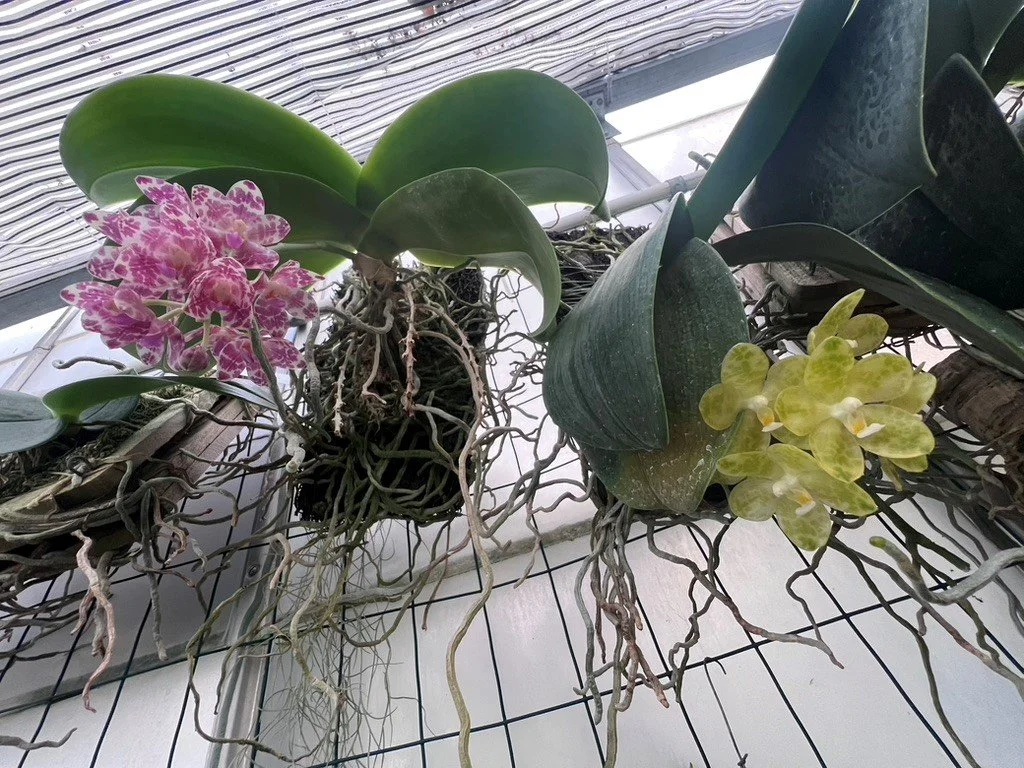
The flowers of Phalaenopsis pallens are smaller and more delicate than their showier hybrid cousins. The petals & sepals of the flowers range from a soft pale yellow to a creamy ivory color (‘pallens’ is Latin for pale). They are typically 2-4 cm (3/4 inch to an inch & a half) across.

Flower spikes can be put out in the fall, winter or early spring. The spikes tend to be no longer than the leaves. Each spike can carry from 1 to 4 flowers. Each spike can bloom for years. As long as it’s green, don’t cut it off.


The plant itself has a tendency to put out a Keiki on an older spike after it blooms. After they grow enough roots, you can either remove them and start a new plant or leave them to create a ‘mother’ plant. The photo above shows the plant with its Keiki’s.

Now you may not be a Phalaenopsis person but, this is an easy to grow on a windowsill, not too demanding and flowers for multiple years might just make you a believer. If you have the opportunity to get hold of one of these beauties, by all means do so.